Sleep is often treated as a passive state, a period of rest that exists outside the core mechanisms of metabolism. Diet and exercise typically receive the most attention in discussions about weight, hunger, and energy balance, while sleep is framed as supportive rather than central. Over the past two decades, however, research has increasingly challenged this view. Sleep is now understood as a primary regulator of appetite, energy intake, and metabolic signaling. When sleep is disrupted, the systems that govern hunger and satiety shift in ways that are both measurable and consequential.
At the center of this shift is the relationship between sleep and appetite hormones. Chronic sleep deprivation alters hormonal signaling in ways that promote increased hunger, reduced satiety, and preference for calorie-dense foods. These effects occur independently of willpower or conscious food choices, suggesting that sleep loss rewires appetite regulation at a biological level.
Understanding this relationship requires moving beyond surface-level explanations and examining how sleep interacts with endocrine, neurological, and metabolic systems.
Appetite Regulation Is a Hormonal Process
Hunger and fullness are not governed solely by stomach volume or calorie intake. They are regulated by a network of hormones that communicate energy status between the gut, brain, and peripheral tissues. Among the most influential are ghrelin, which stimulates appetite, and leptin, which signals satiety.
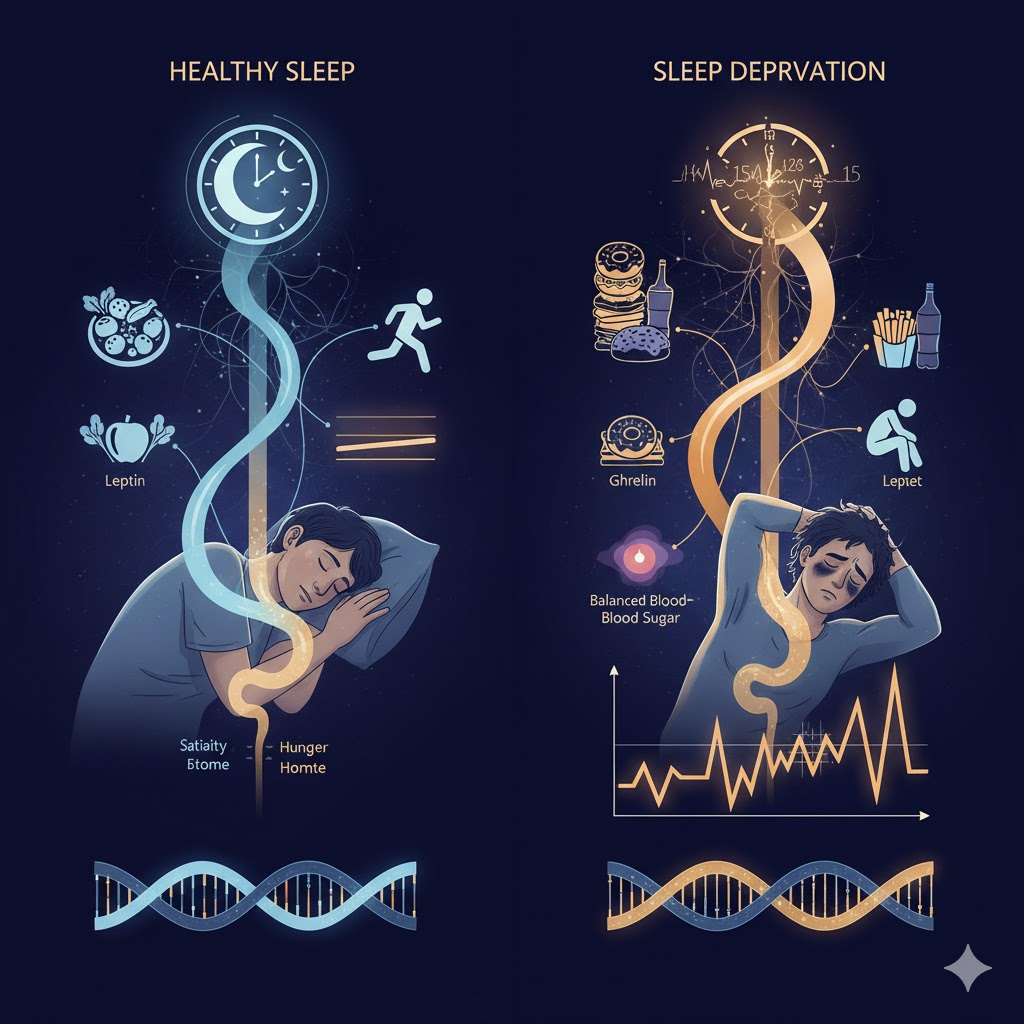
Under normal conditions, these hormones fluctuate in response to food intake, energy expenditure, and circadian rhythms. Sleep plays a critical role in maintaining this balance. During adequate sleep, leptin levels rise, and ghrelin levels fall, supporting appetite control and energy stability the following day.
When sleep is shortened or fragmented, this balance is disrupted. Research published in The Journal of Clinical Endocrinology & Metabolism has shown that even a single night of sleep restriction can reduce leptin and increase ghrelin, creating a hormonal environment that favors hunger over satiety.
What Happens to Appetite Hormones During Sleep Loss
Sleep deprivation affects appetite hormones in both magnitude and timing. Ghrelin secretion increases, particularly during the daytime, amplifying hunger signals even when energy needs are already met. At the same time, leptin signaling becomes impaired, reducing the brain’s ability to register fullness.
This hormonal shift does not simply increase hunger. It changes the type of hunger experienced. Studies have found that sleep-deprived individuals show increased desire for high-carbohydrate and high-fat foods, particularly those that provide rapid energy.
The National Institutes of Health has reported that sleep loss alters activity in brain regions associated with reward processing, increasing responsiveness to food cues. This means that appetite regulation becomes less about physiological need and more about hedonic drive, making overeating more likely even in controlled environments.
Circadian Rhythms and Meal Timing
Sleep and appetite hormones are tightly linked to circadian rhythms, the internal clock that coordinates physiological processes across a 24-hour cycle. When sleep timing is misaligned, such as in shift work or irregular schedules, appetite regulation suffers.
Late sleep onset and reduced sleep duration delay leptin release and prolong ghrelin elevation. This creates a window of increased hunger during late evening hours, a time when energy expenditure is typically low. As a result, sleep-deprived individuals are more likely to eat later at night, compounding metabolic strain.
Harvard Health Publishing has noted that circadian misalignment affects not only hunger hormones but also insulin sensitivity, suggesting that late-night eating under sleep-deprived conditions may amplify metabolic dysfunction.
Sleep Deprivation and Energy Intake
One of the most consistent findings in sleep research is that people eat more when they sleep less. Importantly, this increase in energy intake is not fully compensated for by increased energy expenditure. In other words, sleep deprivation tends to create a positive energy balance.
Controlled studies show that individuals restricted to four to five hours of sleep consume hundreds of additional calories per day compared to those who sleep seven to nine hours. These calories are disproportionately drawn from snacks and ultra-processed foods rather than structured meals.
This pattern suggests that sleep deprivation shifts eating behavior toward opportunistic intake rather than regulated nourishment. Appetite hormones drive this behavior by increasing hunger frequency and weakening satiety signals.
The Role of Stress Hormones
Sleep loss does not affect appetite hormones in isolation. It also elevates cortisol, the body’s primary stress hormone. Elevated cortisol increases appetite and promotes cravings for quick energy sources.
Cortisol interacts with ghrelin and leptin signaling, further amplifying hunger under sleep-deprived conditions. This hormonal convergence creates a state in which the body behaves as though it is under threat, prioritizing energy acquisition over long-term balance.
Chronic exposure to this hormonal environment may help explain why sleep deprivation is associated with long-term weight gain and metabolic dysfunction, even when calorie intake appears only modestly elevated.
Appetite Regulation Beyond the Gut
Sleep deprivation also affects appetite through neurological pathways. Functional imaging studies show that sleep loss reduces activity in the prefrontal cortex, the region responsible for impulse control and decision-making. At the same time, it increases activation in reward-related brain areas.
This combination weakens top-down regulation of eating behavior. Individuals may recognize that they are not physically hungry, yet still feel compelled to eat. In this context, appetite regulation becomes less responsive to physiological cues and more driven by emotional and environmental triggers.
These changes highlight why sleep and appetite hormones must be understood within a broader neuroendocrine framework rather than as isolated signals.
Long-Term Metabolic Consequences
Over time, repeated disruption of sleep and appetite hormones may contribute to insulin resistance, weight gain, and metabolic disease. Elevated ghrelin and reduced leptin signaling promote chronic overeating, while sleep-related insulin resistance impairs glucose handling.
Epidemiological studies have consistently linked short sleep duration with a higher risk of obesity and type 2 diabetes. While these associations are multifactorial, altered appetite regulation appears to be a key mediating factor. Metabolic health resources on Dr. Berg’s blog often emphasize sleep as a foundational regulator rather than an optional lifestyle variable. This viewpoint aligns with the growing recognition that appetite control cannot be optimized without adequate sleep.
Why Willpower Is Not the Issue
One of the most important implications of sleep-related appetite dysregulation is that it reframes overeating under sleep-deprived conditions as a biological response rather than a behavioral failure. Hormonal signals drive hunger, cravings, and food-seeking behavior regardless of intention.
This understanding helps explain why dietary interventions often fail when sleep is insufficient. Efforts to control intake without addressing sleep deprivation place individuals in direct opposition to their own hormonal signaling.
Addressing sleep quality may therefore be a prerequisite for sustainable appetite regulation, rather than a secondary consideration.
Sleep as a Metabolic Input
Traditionally, metabolism has been viewed through the inputs of food and movement. Sleep is increasingly recognized as a third pillar, influencing how those inputs are processed and interpreted by the body.
Adequate sleep supports balanced appetite hormones, stable energy intake, and improved insulin sensitivity. In contrast, chronic sleep deprivation creates a hormonal environment that favors excess intake and reduced metabolic efficiency.
This shift in perspective positions sleep not as passive recovery time, but as an active metabolic input that shapes appetite regulation on a daily basis.
The relationship between sleep deprivation and appetite regulation reveals how deeply interconnected human physiology truly is. Disrupting sleep does not merely produce fatigue. It alters hormonal signaling, neural processing, and metabolic priorities in ways that reshape eating behavior.
Understanding sleep and appetite hormones as part of a unified regulatory system allows for a more realistic approach to metabolic health. Rather than focusing solely on food choices or calorie targets, this framework emphasizes restoring the biological conditions under which appetite regulation can function properly.
As sleep science continues to advance, it is becoming increasingly clear that appetite does not begin in the stomach. It begins the night before, shaped by how well the body is allowed to rest, repair, and recalibrate.